How Can a 58U Chemical Pump Mechanical Seal Deliver Reliable Performance in Highly Corrosive Applications
Handling aggressive chemical fluids requires more than an ordinary sealing solution. The 58U Chemical Pump Mechanical Seal from Qixing is designed for demanding corrosive-fluid applications, offering a wide shaft size range, flexible material configurations, and an operating temperature range of -40°C to +250°C. For chemical processing plants, industrial pump manufacturers, and maintenance professionals, understanding its specifications and selection requirements is essential to achieving reliable sealing performance, reducing leakage risks, and improving equipment service life.
Article Summary: This guide explains the structure, technical specifications, material options, dimensional requirements, and application considerations of the 58U Chemical Pump Mechanical Seal. It also compares the 58U and 59U configurations and provides practical purchasing recommendations for industrial buyers seeking a suitable mechanical seal for corrosive chemical services.
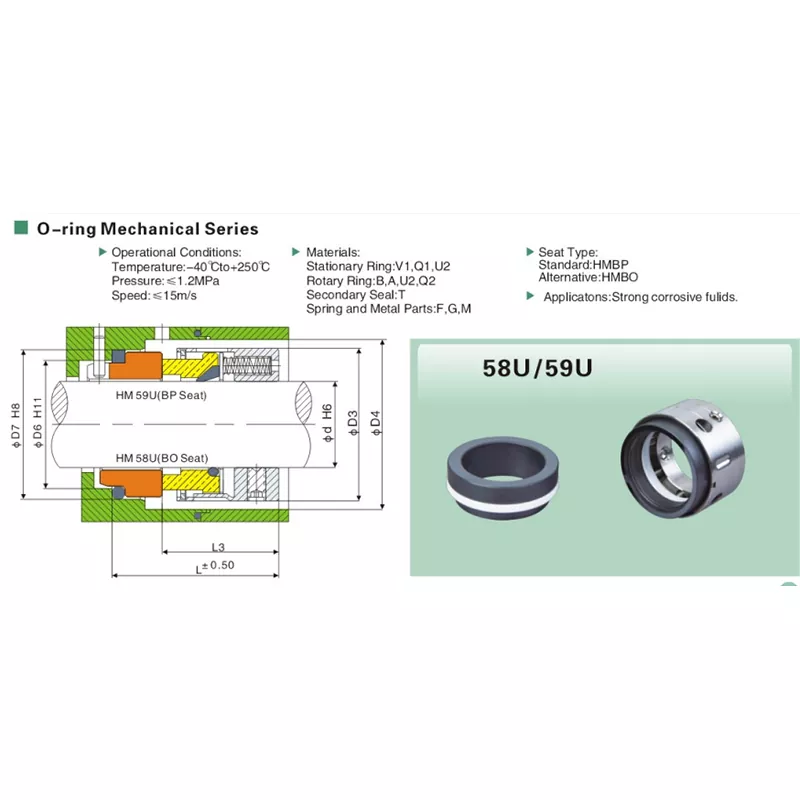
Table of Contents
1. What Is a 58U Chemical Pump Mechanical Seal?
2. Key Technical Specifications and Operating Conditions
3. Understanding the 58U Mechanical Seal Material Options
4. 58U vs. 59U: What Are the Main Differences?
5. How to Select the Correct 58U Mechanical Seal Size
6. Why Is Chemical Compatibility Important?
7. Industrial Applications and Purchasing Considerations
8. Why Choose Qixing for Chemical Pump Mechanical Seals?
1. What Is a 58U Chemical Pump Mechanical Seal?
A mechanical seal is a critical component in centrifugal and other industrial pumps. It prevents process liquids from escaping through the gap between the rotating shaft and the stationary pump housing. In chemical processing environments, this function becomes particularly important because many transported liquids are corrosive, reactive, or sensitive to leakage.
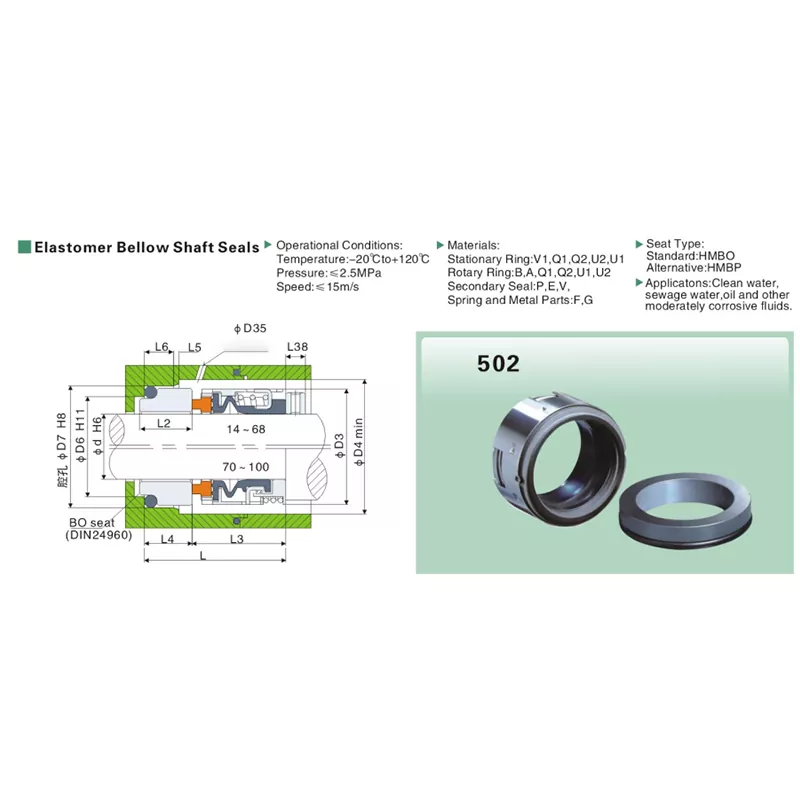
The 58U Chemical Pump Mechanical Seal belongs to the O-ring mechanical seal series and is specifically listed for applications involving strong corrosive fluids. Its configuration is intended to support demanding industrial sealing conditions where material compatibility and accurate dimensional matching are essential.
Compared with selecting a standard mechanical seal based only on shaft diameter, choosing a 58U requires a more comprehensive assessment of the operating environment.
Important selection factors include:
- Fluid characteristics: The chemical composition and concentration of the pumped medium.
- Operating temperature: Normal and maximum process temperatures.
- Working pressure: The pressure conditions inside the pump chamber.
- Shaft dimensions: Accurate shaft diameter and installation measurements.
- Material compatibility: Suitable stationary rings, rotary rings, secondary seals, and metal components.
By considering these factors together, buyers can reduce the risk of premature seal failure and improve the reliability of chemical pumping systems.
2. Key Technical Specifications and Operating Conditions
Understanding the technical operating window is the first step when evaluating whether a 58U Chemical Pump Mechanical Seal is suitable for a particular application.
According to Qixing's product specifications, the 58U/59U product family covers shaft sizes from 14 mm to 100 mm and supports a listed temperature range of -40°C to +250°C. Its maximum listed pressure is 1.2 MPa, while the maximum sliding speed is 15 m/s.
| Technical Parameter | Specification |
|---|---|
| Product Name | 58U Chemical Pump Mechanical Seal |
| Product Series | O-ring Mechanical Seal Series |
| Shaft Diameter Range | 14–100 mm |
| Operating Temperature | -40°C to +250°C |
| Maximum Pressure | ≤ 1.2 MPa |
| Maximum Sliding Speed | ≤ 15 m/s |
| 58U Stationary Seat | BO |
| Stationary Ring Codes | V1 / Q1 / U2 |
| Rotary Ring Codes | B / A / U2 / Q2 |
| Secondary Seal Code | T |
| Spring and Metal Part Codes | F / G / M |
| Recommended Application | Strong Corrosive Fluids |
Important: These values represent the listed product operating limits, not a guarantee that every material combination is suitable for all conditions within the entire range. Actual chemical compatibility, pressure, temperature, and material performance must be evaluated together before ordering.
For applications operating close to the maximum temperature or pressure, buyers should provide complete working-condition information so that the appropriate configuration can be reviewed.
3. Understanding the 58U Mechanical Seal Material Options
Material selection is one of the most important considerations when purchasing a chemical pump mechanical seal. Different chemical liquids can react differently with sealing materials, and even small changes in concentration or operating temperature may affect material compatibility.
The Qixing 58U/59U series identifies several material codes for different sealing components.
3.1 Stationary Ring Materials
The available stationary ring codes include:
- V1
- Q1
- U2
The stationary ring provides a stable sealing surface against the rotating ring. Its material selection should account for the pumped medium, temperature, and operating conditions.
3.2 Rotary Ring Materials
The rotary ring options include B, A, U2, and Q2. These codes identify different material configurations within the product series. The correct combination should be selected according to the application rather than assuming that one option works universally.
3.3 Secondary Sealing and Metal Components
The product specifications also identify T as the secondary seal code and F, G, and M as spring and metal part codes.
When evaluating material combinations, buyers should consider the following:
- Confirm the exact chemical name and concentration.
- Identify the normal and maximum operating temperatures.
- Check the compatibility of the stationary and rotary ring materials.
- Evaluate the secondary sealing material under the actual process conditions.
- Confirm the suitability of springs and metal components for the chemical environment.
For buyers who do not know the required material codes, providing the chemical medium and operating parameters to Qixing is a practical starting point for configuration review.
4. 58U vs. 59U: What Are the Main Differences?
The 58U and 59U belong to the same chemical pump mechanical seal family and share a dimensional specification table. However, their stationary seat configurations have an important distinction that buyers should understand before purchasing replacement components.
| Comparison Item | 58U | 59U |
|---|---|---|
| Product Family | O-ring Mechanical Series | O-ring Mechanical Series |
| Application | Strong Corrosive Fluids | Strong Corrosive Fluids |
| Stationary Seat in Drawing | BO | BP |
| Shaft Size Range | 14–100 mm | 14–100 mm shared family table |
| Material Selection | Multiple material codes | Multiple material codes |
One detail deserves particular attention: the product page identifies BP as the standard seat and BO as an alternative at the overall series level, while the individual drawings label the 58U with a BO seat and the 59U with a BP seat.
Therefore, buyers should not determine the seat configuration from the family description alone.
Before ordering a replacement seal, it is advisable to:
- Check the original mechanical seal model.
- Compare the stationary seat arrangement.
- Verify all critical installation dimensions.
- Provide photographs of the existing seal if available.
- Confirm the required configuration with the manufacturer.
This verification process helps prevent incorrect replacement orders and unnecessary equipment downtime.
5. How to Select the Correct 58U Chemical Pump Mechanical Seal Size
Dimensional accuracy is essential for proper mechanical seal installation. Even when the product model appears correct, differences in installation dimensions may cause fitting difficulties or sealing problems.
The shared 58U/59U dimensional table covers shaft diameters from 14 mm to 100 mm. In addition to shaft diameter, buyers should check dimensions D3, D4, L, L3, D6, and D7.
5.1 Representative 58U Dimension Reference
| Model | d (mm) | D3 (mm) | D4 (mm) | L (mm) | L3 (mm) | D6 (mm) | D7 (mm) |
|---|---|---|---|---|---|---|---|
| 58U-14 | 14 | 32 | 34 | 42.5 | 30.5 | 21 | 25 |
| 58U-20 | 20 | 38 | 40 | 45.0 | 31.5 | 29 | 35 |
| 58U-25 | 25 | 44 | 46 | 47.5 | 34.5 | 34 | 40 |
| 58U-30 | 30 | 49 | 51 | 50.0 | 38.5 | 39 | 45 |
| 58U-40 | 40 | 61 | 65 | 52.5 | 39.5 | 51 | 58 |
| 58U-50 | 50 | 71 | 75 | 57.5 | 44.0 | 62 | 70 |
| 58U-60 | 60 | 85 | 90 | 62.5 | 49.0 | 72 | 80 |
| 58U-70 | 70 | 95 | 104 | 70.0 | 55.5 | 83 | 92 |
| 58U-80 | 80 | 109 | 114 | 70.0 | 55.0 | 95 | 105 |
| 58U-100 | 100 | 129 | 134 | 75.0 | 60.0 | 115 | 125 |
Note: All dimensions are in millimeters. These are representative entries from the manufacturer's dimensional table. Consult the complete product drawing for intermediate sizes and final installation verification.
5.2 Why Should Buyers Verify Multiple Dimensions?
Shaft diameter alone does not determine whether a mechanical seal can be installed correctly. The overall assembly must match the pump's installation space and sealing arrangement.
For replacement projects, the following information is particularly useful:
- Original seal model and identification number.
- Shaft diameter and relevant installation dimensions.
- Stationary seat configuration.
- Existing material codes, if available.
- Photographs or technical drawings of the old assembly.
Providing this information helps manufacturers assess dimensional compatibility before production or shipment.
6. Why Is Chemical Compatibility Important?
Chemical compatibility directly affects the service life and operational reliability of mechanical seals. A sealing material that performs well in water or neutral liquids may not be suitable for a highly corrosive chemical medium.
Several variables influence the suitability of a mechanical seal in chemical processing applications.
6.1 Chemical Composition and Concentration
Different concentrations of the same chemical may produce different compatibility requirements. Buyers should provide the actual process concentration rather than relying on the chemical name alone.
6.2 Temperature Variations
Temperature affects material properties and chemical reactions. A material combination that performs satisfactorily at moderate temperatures may have different limitations under extreme operating conditions.
6.3 Pressure and Sliding Speed
Pressure and sliding speed influence the mechanical demands placed on the sealing interface. The 58U product specifications list a maximum pressure of 1.2 MPa and a maximum sliding speed of 15 m/s. Actual operating conditions should remain within the applicable limits of the selected configuration.
6.4 Installation and Maintenance
Even a correctly selected seal can experience premature failure if installation is inaccurate or operating conditions are unsuitable.
Recommended maintenance practices include:
- Inspecting sealing surfaces during scheduled maintenance.
- Checking shaft alignment and runout.
- Monitoring abnormal vibration and temperature changes.
- Following the pump manufacturer's installation instructions.
- Investigating leakage promptly instead of continuing operation without inspection.
A systematic approach to chemical compatibility and maintenance helps improve equipment reliability and reduce unexpected downtime.
7. Industrial Applications and Purchasing Considerations
The 58U Chemical Pump Mechanical Seal is listed for strong corrosive fluids, making it a product worth evaluating for industrial chemical-handling systems.
Potential application environments include:
- Chemical processing: Pumping aggressive process liquids in chemical production facilities.
- Industrial fluid transfer: Sealing equipment used to transfer corrosive liquids between process stages.
- Specialized manufacturing: Pump systems handling chemically demanding production fluids.
- Industrial maintenance: Replacement projects involving compatible 58U mechanical seal configurations.
Actual suitability depends on the chemical medium, concentration, temperature, pressure, speed, and selected material combination. A detailed application review should be completed before installation.
What Information Should Be Prepared Before Requesting a Quotation?
| Required Information | Recommended Details | Purpose |
|---|---|---|
| Fluid Name | Specific chemical or process liquid | Evaluate chemical compatibility |
| Concentration | Percentage or process concentration | Assess corrosive conditions |
| Temperature | Normal and maximum temperature | Review material suitability |
| Pressure | Normal and maximum working pressure | Check operating limits |
| Sliding Speed | Actual operating speed or calculated sliding speed | Verify application requirements |
| Shaft Diameter | Measured shaft size in millimeters | Identify the correct basic model |
| Seat Configuration | BO seat or existing seat photographs | Confirm the correct assembly |
| Existing Seal Data | Drawings, dimensions, model, and material codes | Support replacement matching |
Preparing these details in advance can make technical communication more efficient and help avoid incorrect specifications during procurement.
8. Why Choose Qixing for Chemical Pump Mechanical Seals?
Choosing a reliable mechanical seal manufacturer is important for industrial buyers who need consistent product specifications, technical communication, and replacement support.
Qixing, the mechanical seal brand of Ningbo Yade Fluid Connector Co., Ltd., manufactures and supplies mechanical seals for industrial applications and global buyers.
For the 58U Chemical Pump Mechanical Seal, Qixing supports product selection and customized matching based on relevant technical information.
8.1 Application-Based Product Selection
Rather than relying only on a model number, Qixing can review the customer's chemical medium, concentration, temperature, pressure, and operating speed when evaluating a suitable sealing configuration.
8.2 Dimensional and Replacement Matching
For OEM projects and replacement requirements, buyers can provide samples, technical drawings, existing model references, and dimensional information. These details help support a more accurate assessment of the required seal configuration.
8.3 Multiple Mechanical Seal Product Categories
In addition to chemical pump mechanical seals, Qixing offers several product categories for different industrial sealing requirements, including:
- Single Spring Mechanical Seals
- Multi Spring Mechanical Seals
- Cartridge Mechanical Seals
- Chemical Pump Mechanical Seals
- Rubber Bellow Mechanical Seals
By communicating application conditions and dimensional requirements clearly, industrial customers can work with Qixing to evaluate suitable mechanical seal solutions for their equipment and purchasing projects.
To learn more about the product specifications, visit the Qixing 58U Chemical Pump Mechanical Seal product page.
9. Frequently Asked Questions
Q1: What is the shaft size range of the 58U Chemical Pump Mechanical Seal?
The shared 58U/59U dimensional table covers shaft diameters from 14 mm to 100 mm. Buyers should verify the complete installation dimensions before ordering.
Q2: What is the operating temperature range of the 58U mechanical seal?
The listed operating temperature range is -40°C to +250°C. However, the actual temperature capability depends on the selected material combination and chemical compatibility.
Q3: What is the maximum operating pressure?
The product specifications list a maximum pressure of 1.2 MPa. The suitability of a specific configuration should be confirmed against the actual operating conditions.
Q4: What is the maximum sliding speed of the 58U?
The listed maximum sliding speed is 15 m/s. The actual application should be evaluated according to pump operating parameters and the selected configuration.
Q5: Is the 58U suitable for strong corrosive chemicals?
Yes. Strong corrosive fluids are the stated application category for the 58U/59U product family. However, buyers must provide the specific chemical, concentration, and temperature to verify material compatibility.
Q6: What is the difference between the 58U and 59U mechanical seals?
The main model-specific distinction shown in the product drawings is the stationary seat. The 58U uses a BO seat, while the 59U uses a BP seat. Buyers should verify the actual seat arrangement when selecting a replacement.
Q7: Can the 58U mechanical seal operate at 250°C?
The product series lists a maximum temperature of +250°C. However, not every material combination is automatically suitable for this temperature. The chemical medium and individual component materials must be evaluated before use.
Q8: What material options are available for the 58U?
The listed stationary ring codes are V1, Q1, and U2. Rotary ring codes include B, A, U2, and Q2. The secondary seal code is T, while spring and metal part codes include F, G, and M.
Q9: What information is needed to order a replacement 58U seal?
Buyers should prepare the shaft diameter, installation dimensions, chemical medium, concentration, operating temperature, pressure, speed, seat configuration, and any available old seal photographs or material codes.
Q10: Can Qixing provide customized 58U mechanical seal solutions?
Qixing supports customized selection and matching based on dimensions, samples, drawings, medium information, and operating conditions. Non-standard requirements should be confirmed individually with the manufacturer.
10. Conclusion
Selecting the right 58U Chemical Pump Mechanical Seal involves more than matching a model number or shaft diameter. Chemical compatibility, operating temperature, pressure, sliding speed, material selection, and stationary seat configuration all play important roles in determining whether a sealing solution is suitable for a specific chemical pump.
With a listed shaft size range of 14–100 mm, an operating temperature range of -40°C to +250°C, and multiple material configuration options, the Qixing 58U series provides an option for evaluating demanding corrosive-fluid applications. Accurate technical information and professional configuration review are essential before purchase.
If you are looking for a dependable chemical pump mechanical seal manufacturer, need replacement matching, or require a customized sealing solution for your industrial equipment, Qixing is ready to assist. Visit our product page and contact us today with your drawings, samples, chemical medium details, and operating parameters. Our team can help review your requirements and provide a suitable 58U Chemical Pump Mechanical Seal solution for your project.
Related News
- How Can a W01 Single Spring Mechanical Seal Improve Pump Reliability and Deliver Consistent Sealing Performance
- How Can the M7N Multi Spring Mechanical Seal Improve Industrial Pump Reliability
- How Can a 2NT Single Spring Mechanical Seal Improve Pump Reliability and Sealing Performance
- How Can an M7N Multi Spring Mechanical Seal Improve Pump Sealing Performance
- Technology Upgrades and Service Capabilities Equal Focus — Evolving Competitive Landscape in Seals Market
- Single-Spring vs. Multi-Spring Selection Debate — Operating Conditions Outweigh Spring Count
Leave me a message
News Recommendations