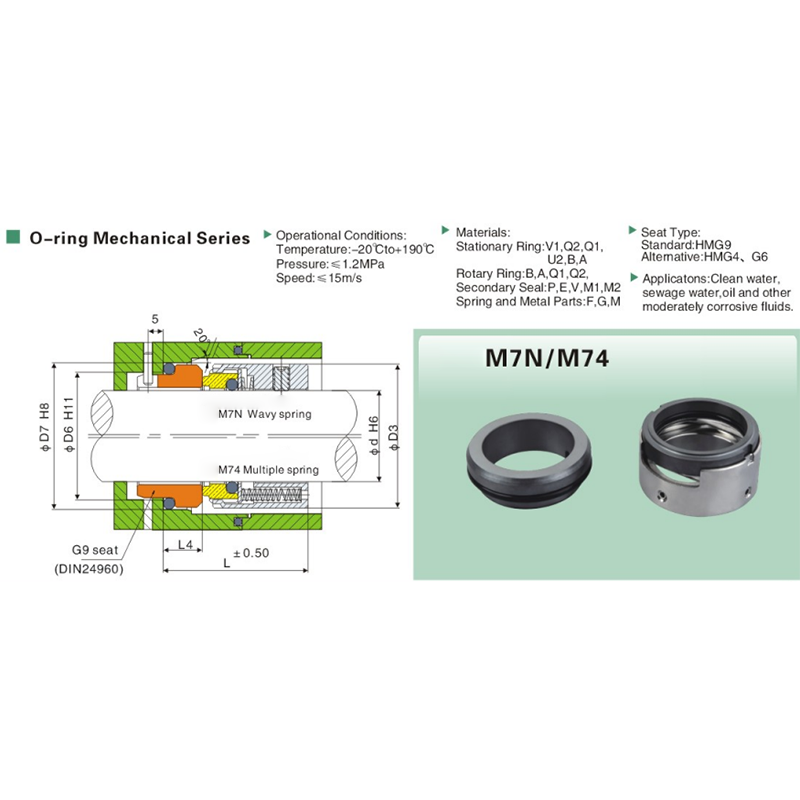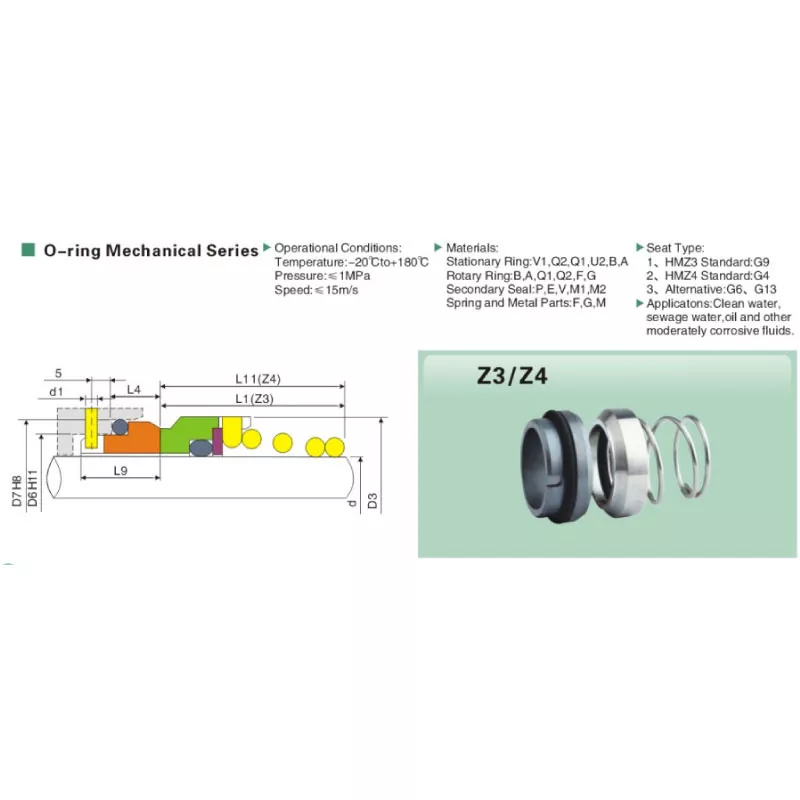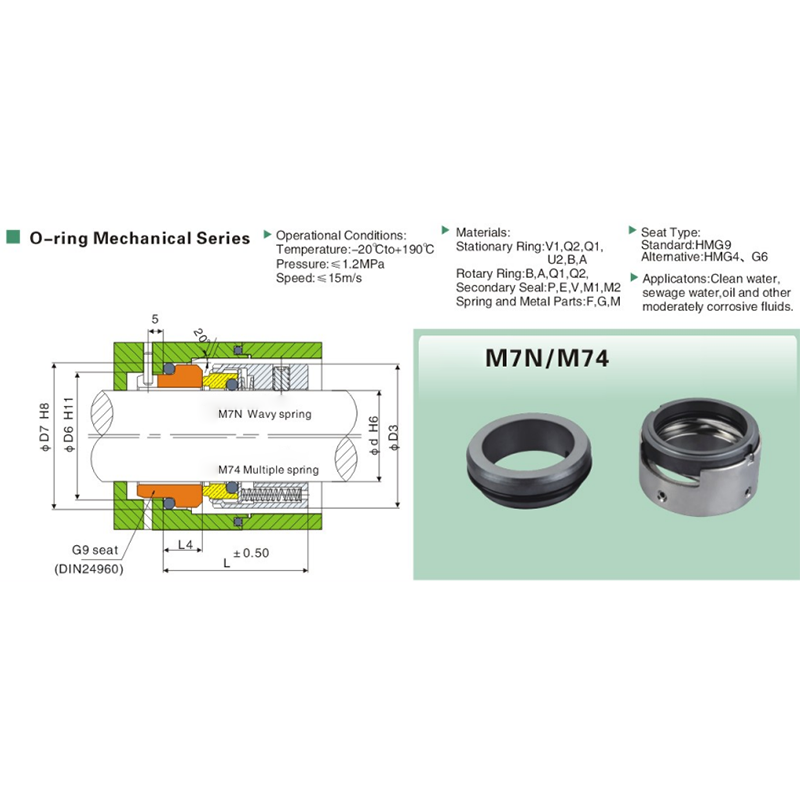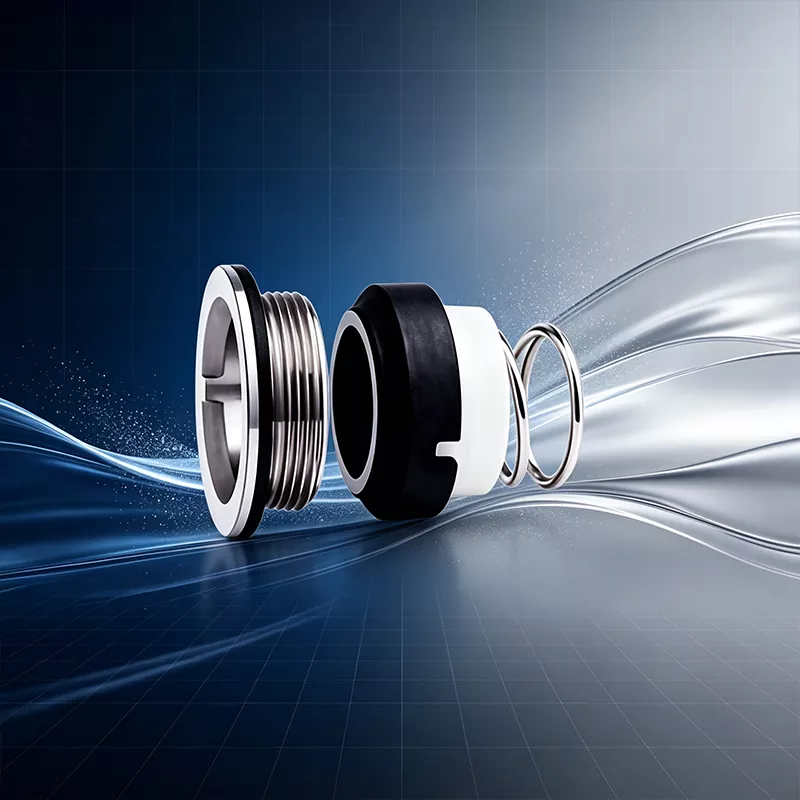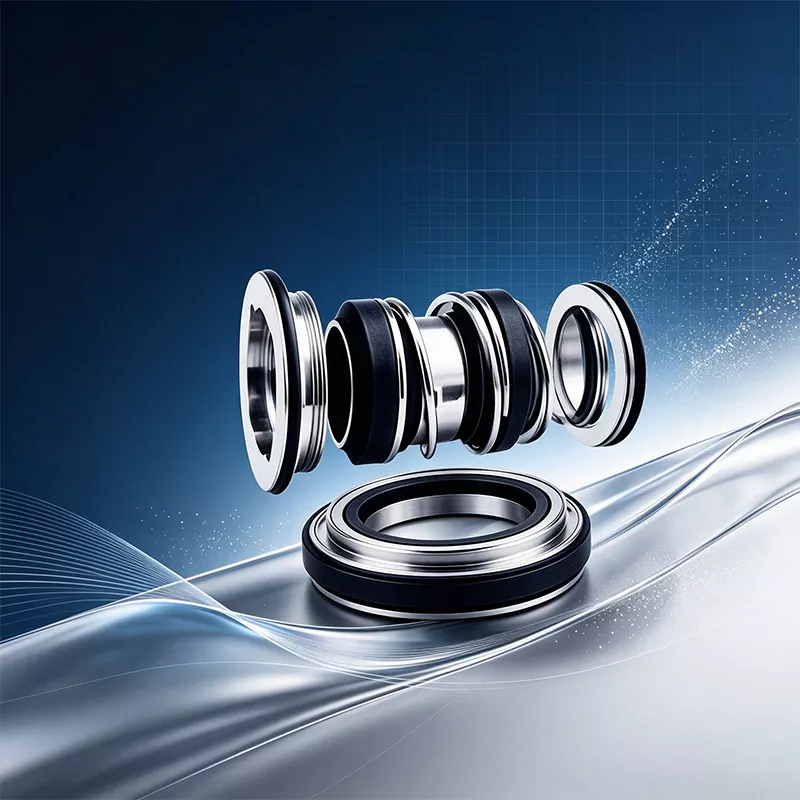
Qixing supplies the M7N Multi Spring Mechanical Seal for industrial pump applications requiring dependable shaft sealing, dimensional flexibility, and material options. Designed for shaft sizes from 14 mm to 100 mm, the M7N supports temperatures from -20°C to +190°C, pressures up to 1.2 MPa, and sliding speeds up to 15 m/s. Its O-ring secondary sealing structure makes it suitable for clean water, sewage water, oil, and other moderately corrosive fluids.
The M7N Multi Spring Mechanical Seal is a practical sealing solution for pumps used in water handling, industrial fluid transfer, oil service, and general process equipment. Its spring-loaded rotating structure, O-ring secondary seal, broad metric size range, and multiple material combinations allow engineers to configure the seal according to operating conditions. For replacement applications, however, selecting the correct seal requires more than matching the shaft diameter. Radial dimensions, axial installation lengths, fixing threads, seat configuration, medium, temperature, pressure, and speed should all be checked before production or purchase.
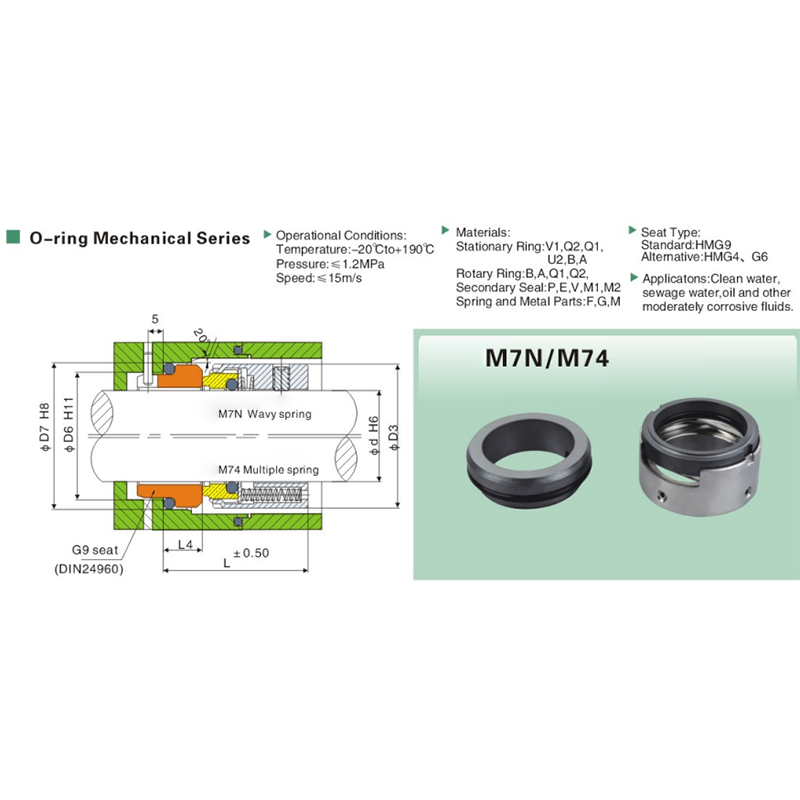
Table of Contents
- What Is an M7N Multi Spring Mechanical Seal?
- What Are the Key Features of the M7N Design?
- What Are the Main Technical Specifications?
- How Should Seal Materials Be Selected?
- Where Can the M7N Be Used?
- How Do You Select the Correct M7N Size?
- What Should Buyers Check for Replacement Projects?
- Why Work With Qixing for M7N Seals?
- Frequently Asked Questions
- How Can You Request an M7N Solution?
What Is an M7N Multi Spring Mechanical Seal?
An M7N Multi Spring Mechanical Seal is an O-ring mechanical seal designed to prevent process fluid from escaping along the rotating shaft of industrial pumps. Unlike a simple static gasket, a mechanical seal maintains controlled contact between rotating and stationary sealing faces while allowing the shaft to rotate.
The M7N design uses a spring-loaded rotating seal structure with an O-ring as the secondary sealing element. This configuration is useful for general industrial equipment because it combines a compact construction with a broad range of available sizes and material combinations.
According to the M7N product specifications, the series covers shaft diameters from 14 mm to 100 mm. This range gives pump manufacturers and maintenance teams multiple options when specifying a replacement or integrating a seal into new equipment.
What Are the Key Features of the M7N Design?
Broad Metric Shaft Size Range
The M7N series is available for shaft diameters between 14 mm and 100 mm. This makes the series applicable to a wide variety of industrial pump configurations, provided the remaining installation dimensions are compatible.
Spring-Loaded Sealing Structure
The spring-loaded rotating structure helps maintain sealing-face contact during normal shaft rotation. Correct installation and operating conditions remain essential because excessive pressure, temperature, speed, shaft movement, or misalignment can affect mechanical seal performance.
Multiple Seat Options
G9 is specified as the standard stationary seat, while G6 and G4 are available as alternative seat configurations. The seat should be selected according to the actual equipment arrangement rather than assuming that every M7N size uses the same installation configuration.
Multiple Material Combinations
The M7N supports different material codes for stationary rings, rotary rings, secondary seals, springs, and metal components. This provides flexibility when the seal must operate with different fluids or under different temperature and pressure conditions.
What Are the Main Technical Specifications?
Understanding the operating envelope is essential before specifying an M7N seal. The following table summarizes the principal specifications published for the series:
| Item | M7N Specification |
|---|---|
| Product Type | M7N Multi Spring Mechanical Seal |
| Seal Structure | O-ring mechanical seal |
| Shaft Diameter | 14–100 mm |
| Operating Temperature | -20°C to +190°C |
| Maximum Operating Pressure | 1.2 MPa |
| Maximum Sliding Speed | 15 m/s |
| Standard Stationary Seat | G9 |
| Alternative Stationary Seats | G6 / G4 |
| Typical Media | Clean water, sewage water, oil, moderately corrosive fluids |
These values define the stated operating range, but they should not be treated as a substitute for application-specific engineering review. When a pump operates close to the upper limits, the complete combination of fluid, pressure, temperature, speed, shaft conditions, and seal materials should be evaluated.
How Should Seal Materials Be Selected?
Material selection is one of the most important considerations when ordering a mechanical seal. The same seal geometry may require different material combinations depending on the pumped medium and operating conditions.
For the M7N series, available material codes include:
- Stationary rings: V1, Q1, Q2, U2, B, A
- Rotary rings: B, A, Q1, Q2
- Secondary seals: P, E, V, M1, M2
- Springs and metal parts: F, G, M
Instead of choosing a material solely because it is commonly used, buyers should provide the actual operating medium and process conditions. Water, sewage, oil, and moderately corrosive fluids can impose very different requirements on sealing faces and elastomers.
Where Can the M7N Be Used?
The M7N Multi Spring Mechanical Seal is intended for industrial pump applications where reliable shaft sealing is required. Typical service environments include:
- Clean-water pumping systems
- Sewage and wastewater equipment
- Industrial oil-transfer pumps
- General fluid circulation systems
- Industrial process pumps
- Pump maintenance and replacement projects
- New pump equipment requiring metric mechanical seals
For sewage, oil, or moderately corrosive applications, buyers should provide information about the actual fluid composition. Temperature and operating conditions can influence whether a particular face and secondary-seal combination is appropriate.
How Do You Select the Correct M7N Size?
One of the most common purchasing mistakes is selecting a mechanical seal only according to shaft diameter. Shaft diameter identifies the basic M7N size, but it does not confirm that the seal will physically fit the pump.
Before placing an order, check the following dimensions and operating information:
- Shaft diameter d: establishes the basic seal size.
- D3, D2 and D1: verify radial installation space.
- d1 and M: confirm the fixing arrangement and thread.
- L1, L2, L3 and L5: verify axial installation length.
- Stationary seat: confirm whether G9, G6, or G4 is required.
- Working medium: supports material selection.
- Temperature, pressure and speed: confirm operating compatibility.
For complex replacement projects, providing an old seal, dimensional drawing, or clear photographs can significantly improve matching accuracy.
What Should Buyers Check for Replacement Projects?
Replacement work requires dimensional verification because two seals with the same shaft diameter may have different installation requirements. The following checklist can help purchasing and maintenance teams prepare an accurate inquiry:
| Check Point | Information to Provide | Purpose |
|---|---|---|
| Basic Size | Shaft diameter d | Identifies the basic M7N size |
| Radial Fit | D3 / D2 / D1 | Confirms available installation space |
| Fixing Arrangement | d1 / M | Checks fixing compatibility |
| Axial Fit | L1 / L2 / L3 / L5 | Confirms installation length |
| Operating Medium | Actual fluid | Supports material selection |
| Operating Duty | Temperature / pressure / speed | Checks application suitability |
| Existing Seal | Photo / sample / drawing | Improves replacement verification |
This approach is particularly useful when the original seal identification marking is incomplete or when a maintenance team is replacing a seal from an older pump.
Why Work With Qixing for M7N Seals?
Qixing, the mechanical seal brand of Ningbo Yade Fluid Connector Co., Ltd., supplies mechanical seals for industrial buyers and replacement applications. For M7N projects, its factory can review dimensional requirements, seat configurations, material combinations, and operating conditions before production.
For buyers seeking a multi spring mechanical seal, the value of technical communication goes beyond simply obtaining a quotation. Providing accurate equipment information allows the supplier to verify the seal against the actual application and reduce the risk of dimensional mismatch.
Qixing also supports customized services and sample-based matching. For replacement requirements, buyers can provide shaft dimensions, installation drawings, photographs, or an existing seal sample together with operating conditions.
Frequently Asked Questions
What shaft sizes are available for the M7N Multi Spring Mechanical Seal?
The M7N series covers shaft diameters from 14 mm to 100 mm.
What is the temperature range of the M7N?
The stated operating temperature range is -20°C to +190°C.
What is the maximum pressure rating?
The maximum operating pressure specified for the M7N is 1.2 MPa.
What is the maximum sliding speed?
The maximum stated sliding speed is 15 m/s.
Which stationary seat is standard?
G9 is the standard stationary seat, while G6 and G4 are available as alternative configurations.
What fluids can the M7N handle?
Typical applications include clean water, sewage water, oil, and other moderately corrosive fluids. Final material selection should be based on the actual medium and operating conditions.
Can I select an M7N only according to shaft diameter?
No. Shaft diameter determines the basic size, but D3, D2, D1, d1, L1, L2, L3, L5, fixing thread M, and seat configuration should also be checked.
Can Qixing match an existing mechanical seal?
Yes. Qixing can review an existing sample, photograph, or dimensional drawing together with the pump's operating conditions to support replacement matching.
What information should I send when requesting a quotation?
Provide the shaft diameter, key installation dimensions, working medium, temperature, pressure, speed, stationary-seat requirement, and any available sample, drawing, or photographs.
How Can You Request an M7N Solution?
Choosing the right mechanical seal starts with accurate dimensional and operating information. Whether you are sourcing replacement seals, developing new pump equipment, or purchasing industrial quantities, Qixing can help review the required M7N configuration according to your actual application. For specifications, customized requirements, sample matching, or factory quotations, contact us with your shaft size, installation dimensions, working medium, temperature, pressure, and speed to receive a more suitable sealing solution.